


Email #1
You're Right On
Week 1 · Permission to start from wherever you are
From: The Studio
Subject: You're Right On

Emotional blocker
"I should be further along than I am."
Lifecycle Marketing · Case Study
The audience: members who'd taken fewer than 10 classes and hadn't booked, taken, or purchased in 30+ days. The lowest-engagement segment in the entire database, where one wrong email kills the relationship for good.
Project Context
Client Profile: Anonymized (Fitness Studio)
Objective: Re-engage low-activity members and convert them into paying, recurring members
Timeline: 6-Month Contract
Status: Protected by Non-Disclosure Agreement

The results
The 1.9% conversion to paid didn't just bring cold members back, it equaled more than $1 million in revenue in the first year. From the segment most programs write off entirely.
First-year revenue
$1M+
Generated by the re-engagement campaign in year one
Conversion to paid
1.9%
The rate that equaled the $1M+ in first-year revenue
Engagement rate
19.7%
From members ignoring every other email
The challenge
Who they were. Members with fewer than 10 classes taken and no booking, class, or purchase in the last 30+ days. Effectively cold, but technically still on the list.
Why they're hard. They aren't unsubscribed, but they're psychologically checked out. Hard sells push them away. Silence loses them entirely.
The strategic question. How do you bring someone back who isn't even sure the studio is for them, without making them feel marketed to?
The strategy
Every email in this 20-week program was shaped by four layers that, together, explained why a member had gone quiet, and what would actually move them. Promotions weren't the lever. Removing blockers was.
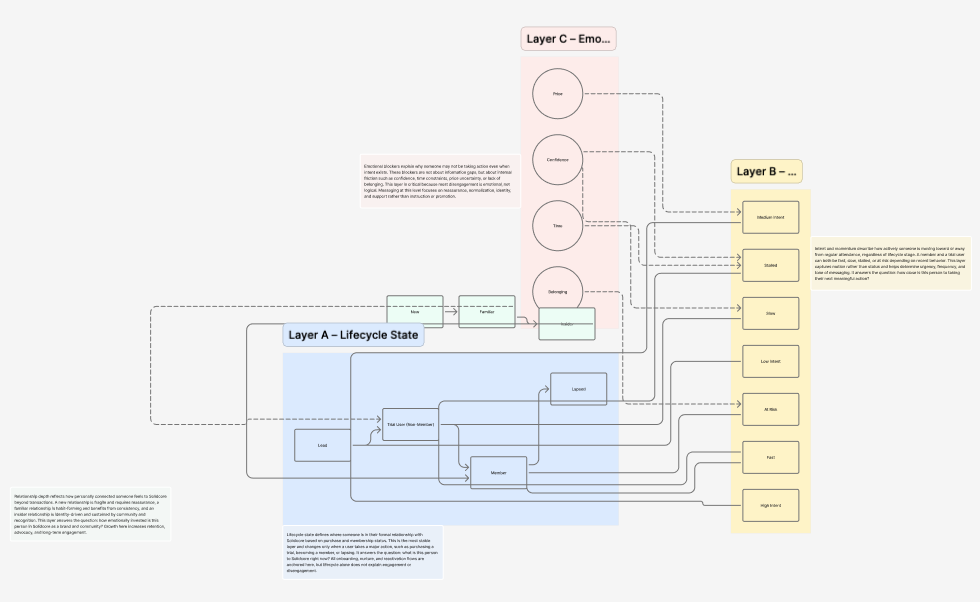
What is this person to the studio right now?
Lifecycle stage defines where someone is in their formal relationship with the studio based on purchase and membership status. This is the most stable layer and changes only when a user takes a major action, such as purchasing a trial, becoming a member, or lapsing. All onboarding, nurture, and reactivation flows are anchored here, but lifecycle alone does not explain engagement or disengagement.
How close is this person to taking their next meaningful action?
Intent and momentum describe how actively someone is moving toward or away from regular attendance, regardless of lifecycle stage. A member and a trial user can both be fast, slow, stalled, or at risk depending on recent behavior. This layer captures motion rather than status and helps determine urgency, frequency, and tone of messaging.
What's actually keeping this person from acting?
Emotional blockers explain why someone may not be taking action even when intent exists. These blockers are not about information gaps, but about internal friction such as confidence, time constraints, price uncertainty, or lack of belonging. Most disengagement is emotional, not logical. Messaging at this level focuses on reassurance, normalization, identity, and support rather than instruction or promotion.
How emotionally invested is this person in the studio as a brand and community?
Relationship depth reflects how personally connected someone feels to the studio beyond transactions. A new relationship is fragile and requires reassurance, a familiar relationship is habit-forming and benefits from consistency, and an insider relationship is identity-driven and sustained by community and recognition. Growth here increases retention, advocacy, and long-term engagement.
Lifecycle tells you who they are. Momentum tells you where they're going. Emotional blockers tell you what's in the way. Relationship depth tells you why they'd come back at all. Layer them, and you stop guessing.
The 5 phases
Each phase mapped to a different combination of emotional blockers, momentum shifts, and relationship depth cues. Here's how it unfolded.
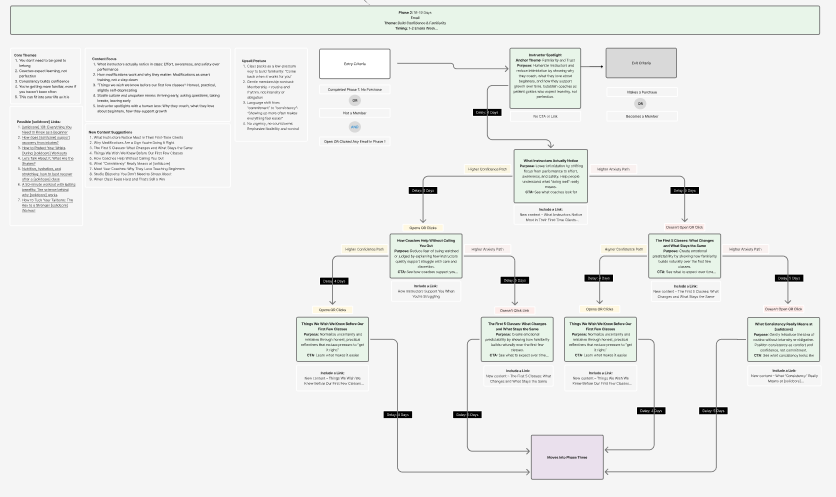
Phase 1 flow, Orientation & Safety
Emotional blocker addressed
"I'm not sure I belong here yet."
Phase 1 assumes nothing and sells nothing. We re-introduce the brand with a no-pressure tone built around first-timer success stories, what a class actually feels like, instructor empathy, and behind-the-scenes from the studio. CTAs stay soft, "when you're ready" framing only, emphasizing flexibility over commitment.
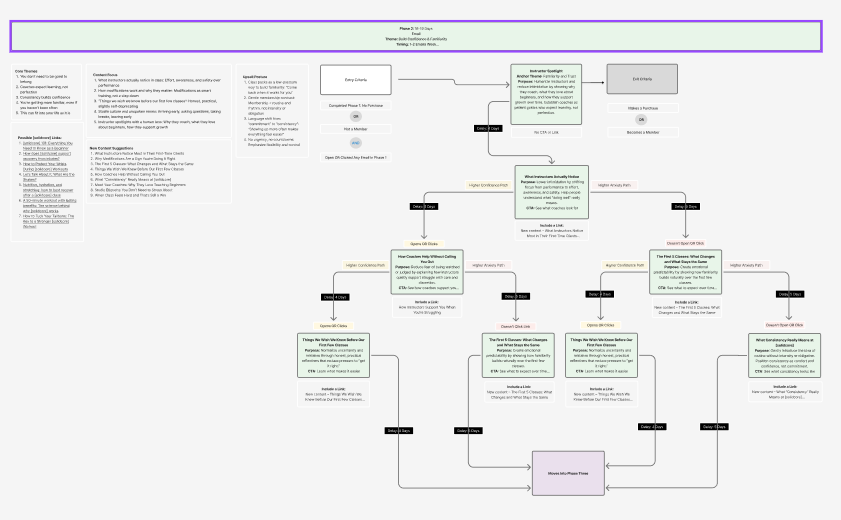
Phase 2 flow, Build Confidence & Familiarity
Emotional blocker addressed
"I'm afraid I'm not good enough to be in the room."
Phase 2 reframes effort over performance. Content covers what instructors actually notice in class, how modifications work as smart training, things we wish we knew before our first few classes, studio culture and unspoken norms, and instructor spotlights with a human lens. Class packs are positioned as a low-pressure way to build familiarity, with language shifting from "commitment" to "consistency."
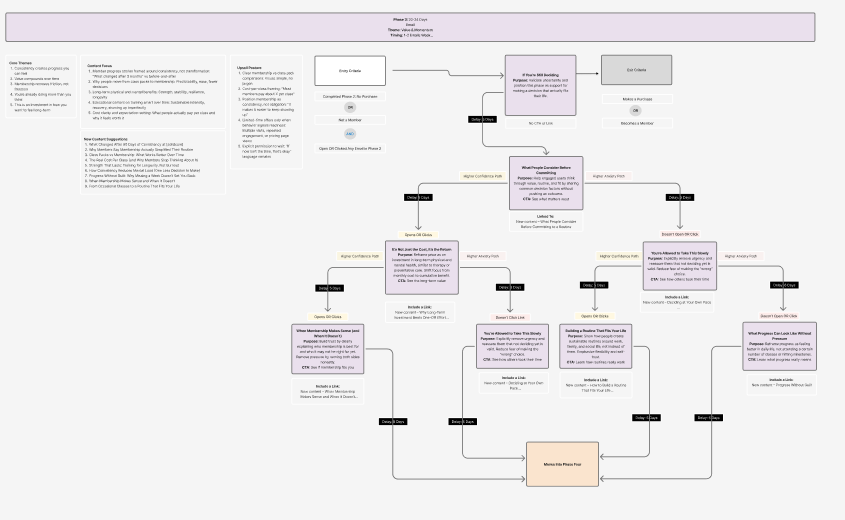
Phase 3 flow, Value & Momentum
Emotional blocker addressed
"I'm not sure membership is worth it for me."
Phase 3 makes the long-term case. Member progress stories framed around consistency (not transformation), why people move from class packs to membership, long-term physical and mental benefits, education on training smart over time, and clear cost-per-class framing. Membership is positioned as removing friction, not adding obligation, with explicit permission to wait if now isn't the time.
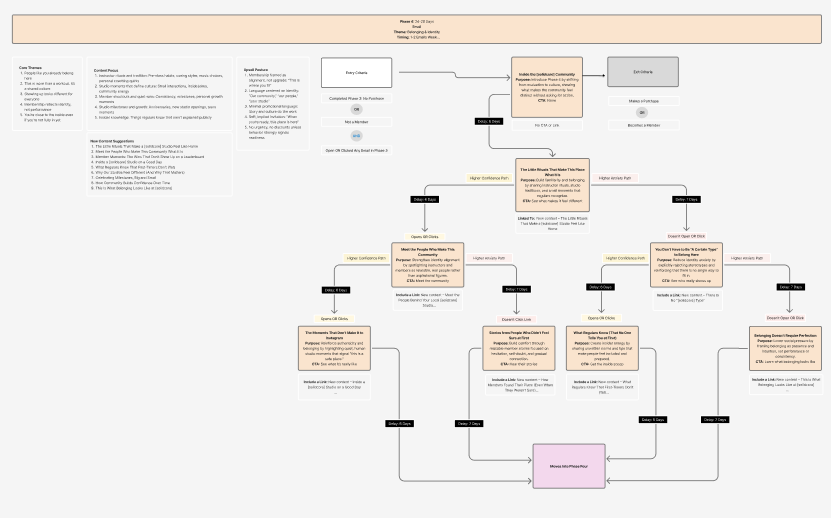
Phase 4 flow, Belonging & Identity
Emotional blocker addressed
"This feels like a community I'm not part of yet."
Phase 4 moves from product to identity. Content centers on instructor rituals and tradition, studio moments that define culture, member shoutouts and quiet wins, studio milestones, and insider knowledge regulars know. Membership is framed as alignment, "this is where you fit", using language like "our community" and "our people." Story and culture do the work; promotional language stays minimal.
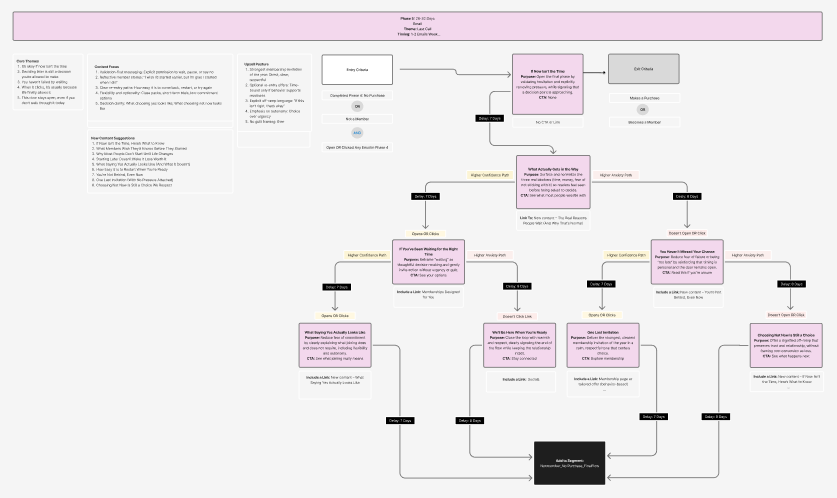
Phase 5 flow, Last Call
Emotional blocker addressed
"I'm just not ready to decide right now."
Phase 5 leads with validation. Reflective member stories ("I wish I'd started earlier, but I'm glad I started when I did"), clear re-entry paths, flexibility through class packs and short-term trials, and decision clarity for both yes and not-now. This is the strongest membership invitation of the year, direct, clear, respectful, paired with explicit off-ramp language: "If this isn't right, that's okay." No guilt framing. Ever.
Phase 1 in the inbox
Five emails over four weeks, each one meeting members exactly where they were, with no pressure to be anywhere else.
Email #1
You're Right On
Week 1 · Permission to start from wherever you are
From: The Studio
Subject: You're Right On
Emotional blocker
"I should be further along than I am."
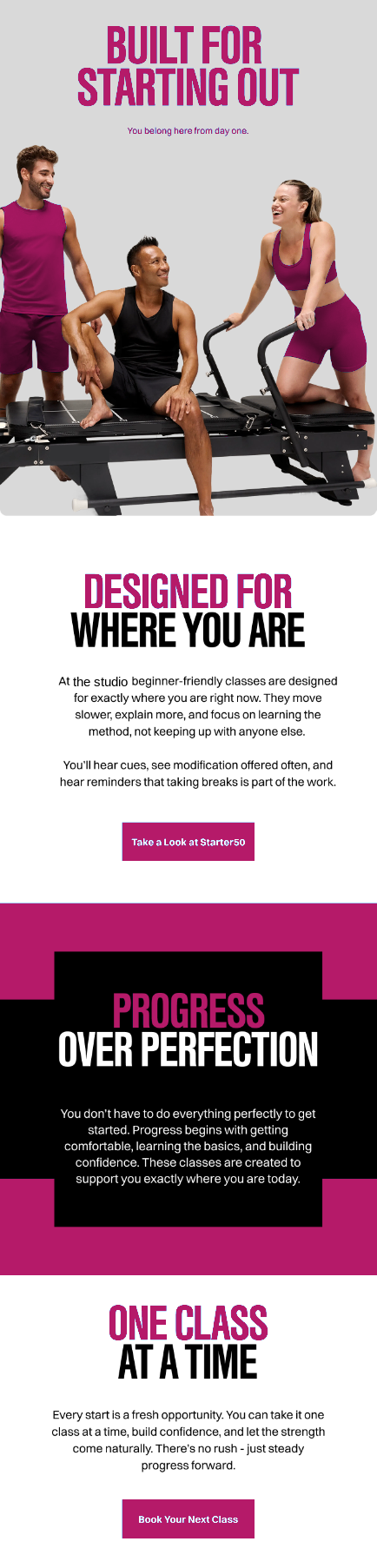
Email #2
Built for Starting Out
Week 1–2 · You belong here from day one
From: The Studio
Subject: Built for Starting Out
Emotional blocker
"I'm not ready for something this intense."
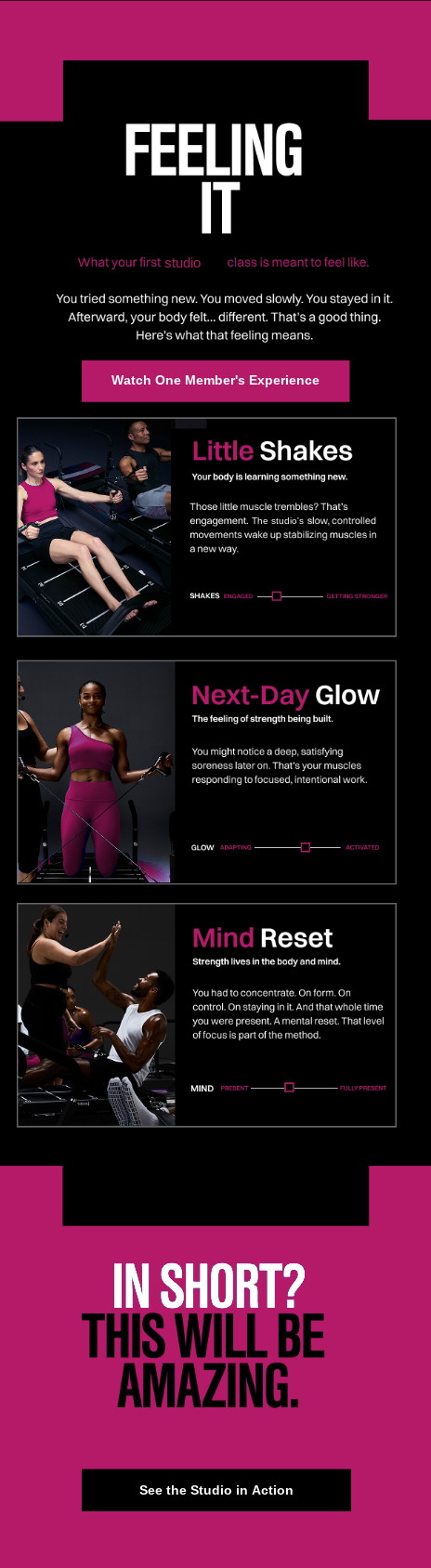
Email #3
Feeling It
Week 2–3 · What your first class is actually meant to feel like
From: The Studio
Subject: Feeling It
Emotional blocker
"I don't know if I'm doing this right."
Email #4
Built for Starting Strong
Week 3 · Progress is designed into the method
From: The Studio
Subject: Built for Starting Strong

Emotional blocker
"I don't know if this will actually work for me."
The engagement gate
If a member didn't engage with any email in Phase 1, they were removed from Phases 2–5 entirely. The strategy treated non-engagement as information, not as a problem to solve with more volume.
That decision protected sender reputation, respected the member's inbox, and concentrated effort on people who'd given even the smallest signal of interest.
Results
The campaign targeted the lowest-engagement segment in the database: members who had gone quiet for 30+ days. These were not warm leads. They were the ones most lifecycle programs ignore.
List size
750K+
Mostly unengaged leads who had stopped opening or clicking
Engagement rate
19.7%
Re-engagement from a segment ignoring all other emails
Conversion to paid
1.9%
Full conversion rate to paid membership purchases from a previously disengaged list
The significance: A 1.9% conversion to paid from a cold, disengaged segment is a strong result in lifecycle marketing. For context, industry benchmarks for re-engagement campaigns typically range from 0.5%–1.2% for reactivation, and these members had already ignored every other touchpoint.
Why this approach
It treated members like humans, not records in a CRM. Every email mapped to a probable mental state, a specific emotional blocker at a specific point in their journey.
It optimized for relationship, not reach. Removing disengaged members wasn't a loss, it was the point. Momentum and relationship depth mattered more than list size.
It made silence productive. Non-opens informed segmentation. Engagement earned more contact. The layers told us what to do when someone didn't respond.
This is the kind of lifecycle work I do. If you're rebuilding a re-engagement program, let's talk.